Friday, April 29, 2016

The Treeline lady

#ashokasays Did you know 159:

She is called Saalumarada Thimmakka in her village.  She got the honour of being named Saalumarada, for the work she has been doing for a long time. The word ‘Saalumarada’ means ‘row of trees’ in Kannada language. Today, she is a renowned environmentalist who held the recognition of being one, who planted and tended 284 banyan trees along a four kilometer stretch of highway. And that is no mean achievement!

It is said that some people are born with an extreme vigour – a vigour that conquers the pain born with an unfulfilled desire. And with great enthusiasm they can reshape a wish too. Saalumarada Thimmakka and her husband are not any different here. The pain of not having children for more than 25 years of their marriage yielded in an idea of planting the banyan saplings along the highway.

One fine day, Thimmakka’s husband decided to plant trees and nourish those like their own children to overcome the sadness. And that particular thought is the beginning of Saalumarada Thimmakka’s great afforestation project.

They found a road in their neighbouring village Kudur, suitable for their purpose, since the road did not have a single tree and that caused immense hardship for the traveler during summer. Initially they planted ten saplings of banyan tree in the first year and the numbers increased with each passing year. In 1991, Saalumarada Thimmakka’s husband died but the tragedy could not restrict her to carry the project ahead. And it is surprising to learn that today, the asset value of the trees stands at more than 1.5 million rupees.

Saalumarada Thimmakka did not confine her work only to planting trees. She has been raising her voice in other social activities too. Situation and determination turned Thimmakka to a crusader Saalumarada. A crusader, who believes in the philosophy: if you want to fill the void of emptiness then plant a dream and nourish it like your own baby.

INCREDIBLE BHARATHIYA


Ramanarayanam-Srimadramayana Pranganam

#ashokasays Did you know 158:

Ramanarayanam-Srimadramayana Pranganam temple one of the most beautiful temples built in Modern India. This one is located at a distance of 35 kilometers from Vishakhapatnam enroute Vizianagaram.

Situated in a sprawling 15 acre expanse near Vizianagaram, Ramanarayanam-Srimdramayana Pranganam, is built in the share pf a Bow & Arrow: the temple took more than a decade to build.

The entire story of Ramayana is sculpted in 3D for the most life like experience in understanding Valmiki Ramayana.


The structures built in the shape of ‘Rama Dhanuvu’ (the sign Sagittarius in the zodiac) has two floors with Sri Maha Vishnu temple on the one and Sri Rama temple on the other. Linking both the temples in the shape of a bow is the ‘Pranava Margam’ that bears all-important ‘khandaas’ of Saint Valmiki’s Srimadhramayana in visual forms.

With Lord Vigneswara temple at the entrance, the path in the shape of an arrow leads to the complex that has colour fountains. At the tip of the arrow, a 60-feet-high Hanuman statue has been installed which is visible even from a distance of 1km. In foreground of the two-floor complex, Sri Lakshmi and Sri Gnana Sarswati idols have been installed.

It is one of the very few places in the world which has a "Veda Patashala" run by TTD.

You can know more about this place and also go through a virtual tour of the place on http://ramanarayanam.org/home.aspx

INCREDIBLE BHARATHA


Lost in Kumbh Mela? Meet him..

#ashokasays Did you know 157:
You read about the Kumbh Mela yesterday. And I'm sure you have seen a lot of Hindi movies where brothers get separated in Kumbh Melanie and are rejoined after many years with some kind of mark on their body.. blah blah blah..

Don't forget to meet this man incase you visit Kumbh Mela...

Fondly known as "Bhule Bhakte Tiwari", Rajaram Tiwari founded Bharat Seva Dal and made it his life's mission to ensure that families found their way to back to each other if they were separated at the Kumbh Mela.

The "Khoya Paya Shivir" camps set up by Tiwari have helped reunite roughly 1 million adults and 20000 children with their family members, while simultaneously breaking clinched Bollywood stereotypes.

Incase you want to read more about him you can visit

http://articles.latimes.com/2013/mar/02/world/la-fg-india-festival-lost-20130303

INCREDIBLE BHARATHIYA


Kumbh Mela

Did you know 156
Kumbh Mela

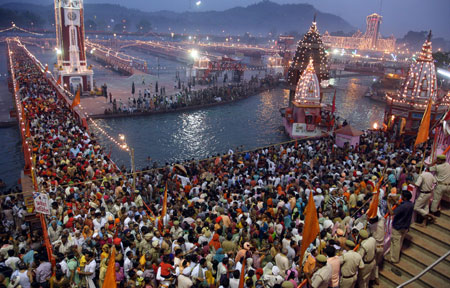
Kumbh Mela is organized every three years on a rotation basis in Allahabad, Nashik, Haridwar and Ujjain. It is a mass Hindu pilgrimage in which Hindus gather at the Sangam, meeting place, of the rivers Ganges, Yamuna and Sarasvati, and on the banks of Godavari, Ganga and Kshipra where bathing for purification from sin is considered especially auspicious.

It’s the world’s biggest fair

The festival is billed as the "biggest gathering on Earth"; in 2001 more than 40 million gathered on the busiest of its 55 days. The 2001 mela was unusually significant due to the planetary positions at the time, a pattern that repeats only once every 144 years.

Kumbha Mela is held at all the four places

Ardha Kumbha Mela: Held at Haridwar and Prayag (Allahabad), every 6 yearsPurna Kumbha Mela: Only at Prayag, every 12 years

Maha Kumbha Mela: Only at Prayag, every 144 years

Various sadhus (hermits) visit the Mela; including Nagas, who do not wear any clothes; Urdhwavahurs, who believe in putting the body through severe austerities; Parivrajakas, who have taken a vow of silence; Shirshasins, who stand 24 hours and meditate for hours standin on their heads; Kalpvasis, who bathe thrice a day.
It’s a spectacle to behold various akharas making it to the river for the great bath on Kumbh days. An akhara is a wrestling arena. It is an organization of the different sects of saints, vairagis, and yogis who have renounced the world. Akharas are divided into different camps according to the concept of God they worship. Shaiva Akharas are for followers of Lord Shiva, Vaishnava or Vairagi Akhara are for followers of Lord Vishnu and Kalpwasis are for followers of Lord Brahma. An Akhara is further divided into 8 davas (divisions) and 52 marhis (centers). Each marhi performs its spiritual activities under a Mahant. The central administrative body of the Akhara is Shree Panch (the body of five), representing Brahma, Vishnu, Shiva. Shakti and Ganesha. The five-member body governing an akhara is elected during every Kumbh Mela for a period of 4 years.


:

INCREDIBLE BHARATHA

NH-22

Did you know 155:
National Highway 22 (NH 22) is a 459 km (285 mi) National Highway in Northern India that runs from Ambala through Chandigarh and Himachal Pradesh up to Khab on the Tibet border. It is also known as Hindustan Tibet road.

The construction of Hindustan Tibet road in Himachal Pradesh began in 1850. It is an exquisite feat of human endeavor, on one of the highest ranges of the world. The half tunneling, done manually through the rocky stretches, speaks volumes of determination and dedication with which the highway was built. The tunneling done through huge rocks at "Khimring Dhankh" or cliff, on the Hindustan Tibet road is still considered to be the largest stretch tunneled for a road through the rocks.

This road has been featured in the History Channel as one of the most “Deadliest Road” in the world. Built in 19th century, the Hindustan-Tibet road, also known as the Silk route or the National Highway No. 22, begins from Ambala in Haryana, as an offshoot of NH.1.

Go for a thrilling drive and enjoy the experience..

INCREDIBLE BHARATHA


Arunachalam Muruganantham - The Menstrual Man

Did you know 154:
Arunachalam Muruganantham - The Menstrual Man

Meet the man who started India's sanitary napkin revolution. His dream? Affordable, hygienic napkins for all.

A true visionary, Arunachalam Muruganantham began the sanitary pad revolution in India. Venturing dangerously close to a topic most men steer clear off, he was shocked when he discovered that women in rural India cannot afford hygienic sanitary napkins. Instead they are forced to use cloth, sand, leaves and even ash!

Today, Muruganantham has developed a low cost, functional and affordable sanitary napkin. He aims to make India a 100% sanitary napkin country.

A school dropout from a poor family in southern India has revolutionized menstrual health for rural women in developing countries by inventing a simple machine they can use to make cheap sanitary pads for which he has secured a patent.

Out of 943 entries which went for a national innovation award, this machine came first. He was given the award by the then President of India, Pratibha Patil - quite an achievement for a school dropout.

The man went through many kinds of troubles from being rejected by his own family members, people whom he tried to interact with suspected him with many suspicions, wife and mother left him, no money to deal with etc. But still he was able to get over all this.When he made to the lime light he not only received all kinds of respect and love from the country, even his family members are back with him.

You should surely read about his inspiring story onhttp://www.bbc.com/news/magazine-26260978. Don't miss reading it.

INCREDIBLE BHARATHIYA


Vijay P Bhatkar

#ashokasays Did you know 153:
Vijay Bhatkar is an Indian computer scientist and a Padma Shri andPadma Bhushan awardee. Dr. Vijay Bhatkar is one of the most acclaimed and internationally acknowledged scientists of India. India's computer magazine Dataquest has placed him among the star pioneers who shaped India's IT industry.

Dr. Bhatkar is best known as the architect of India’s national initiative in supercomputing where he led the development of Param supercomputers. When India was denied the supercomputer by USA, Dr.Bhatkar took the challenge of developing an indigenous supercomputer in a record time of 3 years and delivered Param 8000 in 1991 and went on to develop terascale Param 10000 in 1998, propelling India into the exclusive club of select nations, who possess this strategic technology. Based on the Param series of supercomputers, he built the National Param Supercomputing Facility (NPSF) which has been now made available as a grid computing facility through Garuda grid on the National Knowledge Network (NKN) providing nationwide access to High Performance Computing (HPC) infrastructure. Today, Dr. Bhatkar has once again taken the lead in proposing the National Mission on Development of Exascale Supercomputing Capability, Capacity and Infrastructure on National Knowledge Network.

Dr. Bhatkar is also widely known for bringing ICT to the masses through a wide range of path - breaking initiatives, such as the celebrated GIST multilingual technology covering India’s 22 official languages with 10 diverse scriptsthat has dissolved the language barrier on computers once for all; MKCL’s computer literacy programme that made a world mark by creating 7.5 million computer literates within a decade; Education to Home (ETH) initiativefor bringing the benefits of ICT to school education, in learning, teaching, administration, governance and communication & collaboration.


In the 80’s, Dr Bhatkar substantially contributed to the ushering of electronics revolution in India. He led the development of several innovations such as India’s first fully solid state colour television, colour TV broadcast during Asiad in 1982, distributed control systems for Indian power plants and process industries,traffic control systems, automationof security systems, defence simulators and the like from the component level upward that contributed to building the indigenous foundation of India’ electronics industry which was to become India’s IT industry later.

He is presently the Chancellor of India International Multiversity, Chairman of ETH Research Lab, Chief Mentor of I2IT, and National President of Vijnan Bharati.

INCREDIBLE BHARATHIYA